Breathing Pod
Interaction Design · Physical Computing · Social Connection
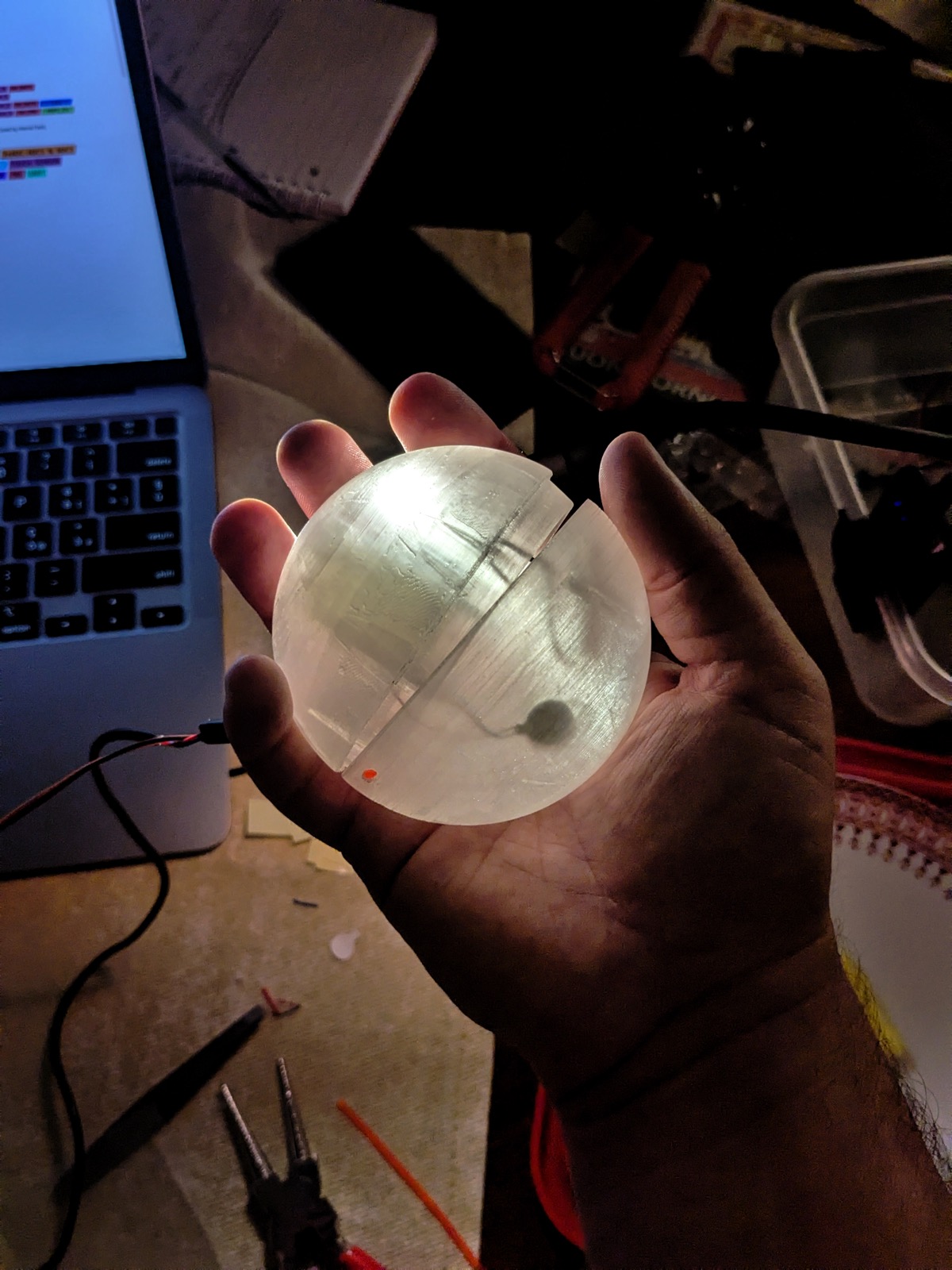
The Breathing Pod is a handheld device that expands with another person's breathing and vibrates with their heartbeat. It puts a body in the hands.
It builds on a concept from the design studio Modem, imagined for their Networked Intimacy project on restoring a felt sense of physical presence across distance. Realized as a working prototype, the Pod becomes a way to test whether that presence actually comes through.
A signal worth sharing
When two people interact in person, their breathing and heart rates drift into sync. The pattern differs for strangers, friends, and partners, a bodily mark of how connected they are.
Wearable sensors made those rhythms shareable, one person's heartbeat and breathing perceptible to another, as social biofeedback.

Earlier research built physical objects for sharing these signals, and holding them did raise empathy and a sense of involvement. No study, though, had compared a physical object with a screen showing the same heartbeat and breathing, leaving the effect of the form itself untested.
The Pod poses two questions. Does holding a person's heartbeat and breathing, rather than watching it on a screen, make you feel closer to them? Does it help you read what they are feeling?
One signal, three forms
To find out, the Pod was set against two other interfaces carrying the same recorded heartbeat and breathing. Only their form differed, so any change in how people responded came from the form alone. The three span a range, from something you read to something you feel.
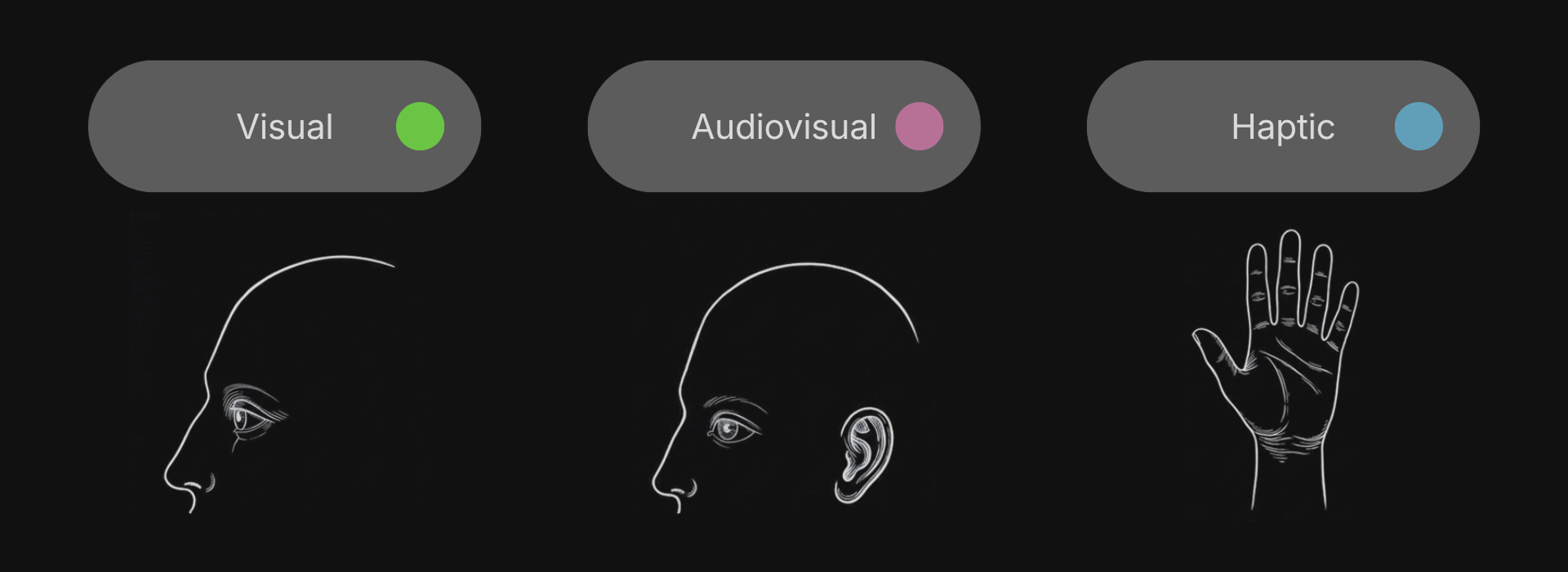
At one end is the chart, a visual interface: breathing and pulse drawn as medical waveforms, the kind of clinical trace you need training to read.
In the middle is the circle, an audiovisual interface: a soft shape that expands with each breath and pulses, with sound, on each heartbeat. It carries the same rhythm as the chart, but you can follow it without decoding anything.
At the far end is the Pod, the tangible interface: nothing on a screen, just an object that expands and vibrates in the hand. Here the heartbeat and breathing are felt, not interpreted.
In Don Ihde's terms, the chart sets up a hermeneutic relation, a representation to be read and interpreted, while the Pod approaches an alterity relation, a thing you meet as a presence of its own. Heartbeat and breathing are the deliberate choice of signal: two rhythms everyone already knows from their own body, legible through the senses without any training.
All three play the same recordings rather than a live partner, so the only thing changing between them is the interface. The recordings come from a single person in the DEAP research dataset, so the underlying physiology is identical across the three. Each is a capture of that person in a different emotional state.
Under the shell
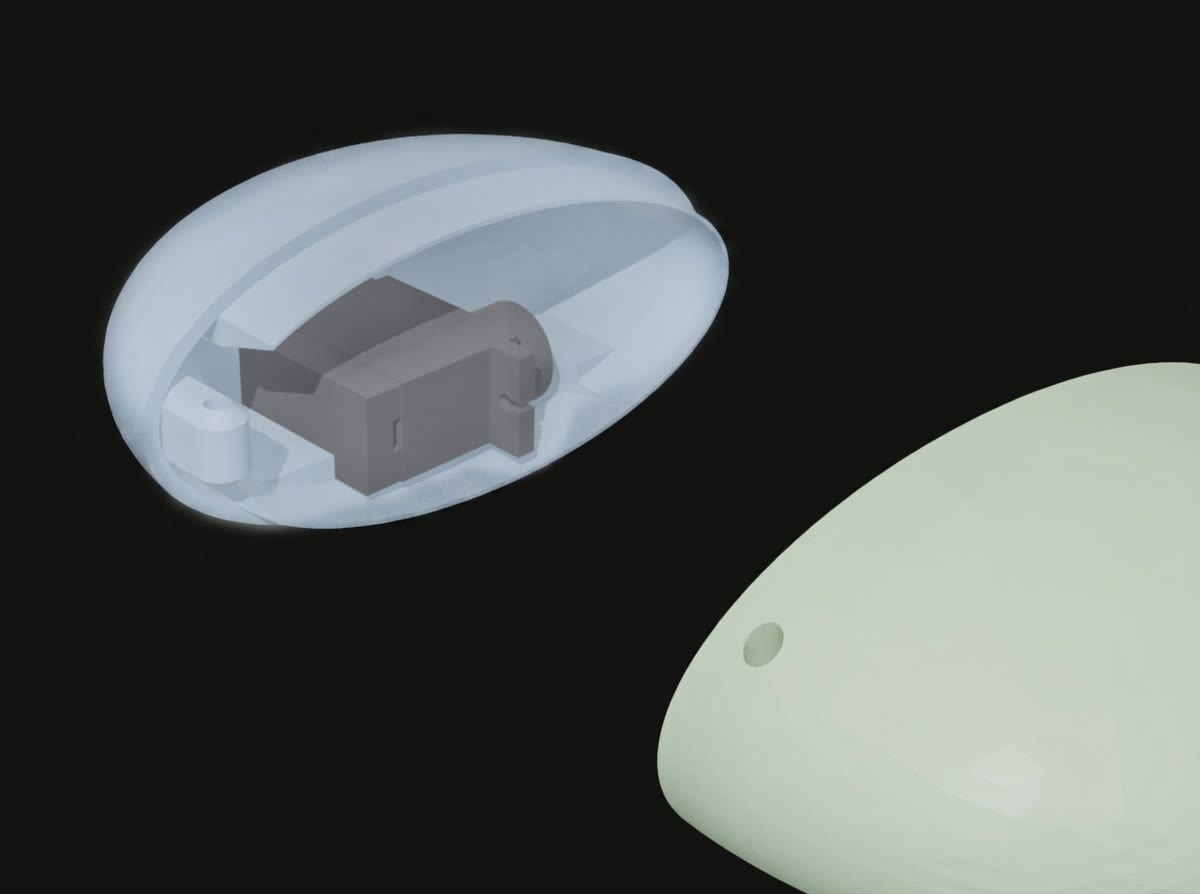
The Pod is an 80-millimeter shell, 3D-printed in translucent PLA, moved by two small motors. A servo motor expands it with each breath; a coin motor vibrates with each heartbeat.
An ESP32 microcontroller drives the two, replaying the recorded breathing and heartbeat, band-pass filtered and downsampled for playback, its original shape and rhythm intact.
Two predictions
Thirteen people tried all three interfaces.
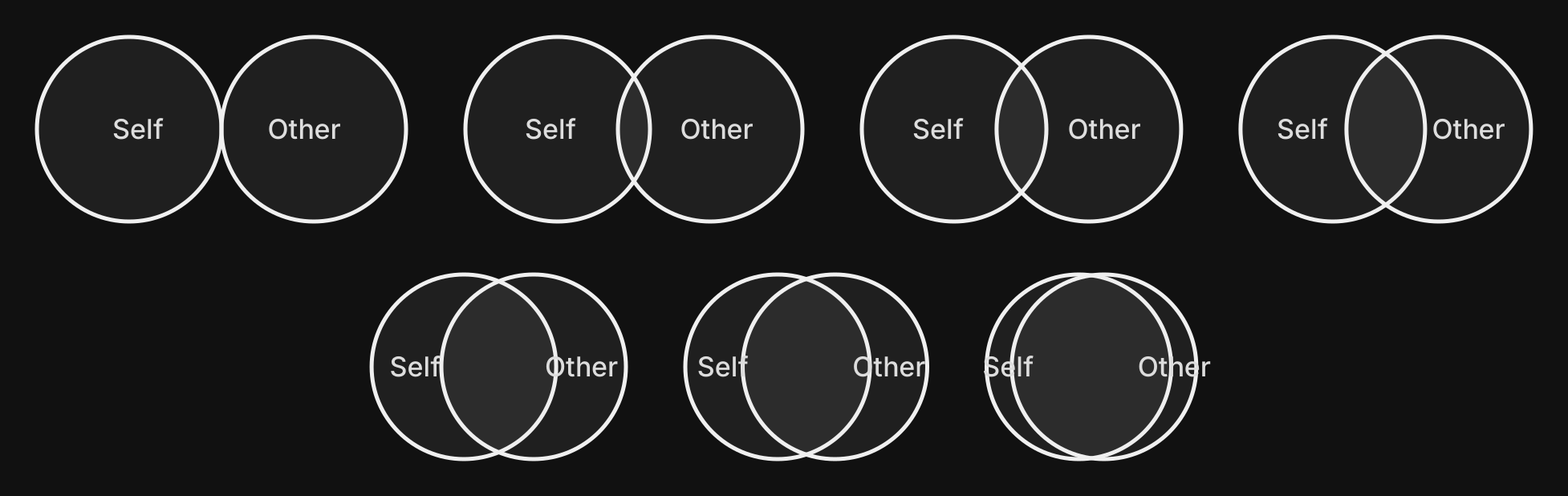
After each, they rated what that person was feeling, from calm to excited and from unpleasant to pleasant, and how close they felt to them.
Two predictions, one for each question. Somaesthetic design theory holds that engaging the body directly, not through visual abstraction, deepens affective and social response, and touch is a socially potent sense. So the Pod should feel the most connecting.
Reading the emotion should favor the circle instead, by multisensory integration: information reaching the two senses at once is perceived more precisely than through one. Seen and heard together, it should make the three emotional states easiest to tell apart.
Connection is not comprehension
The Pod produced the strongest sense of connection, the chart the weakest, and the circle in between.
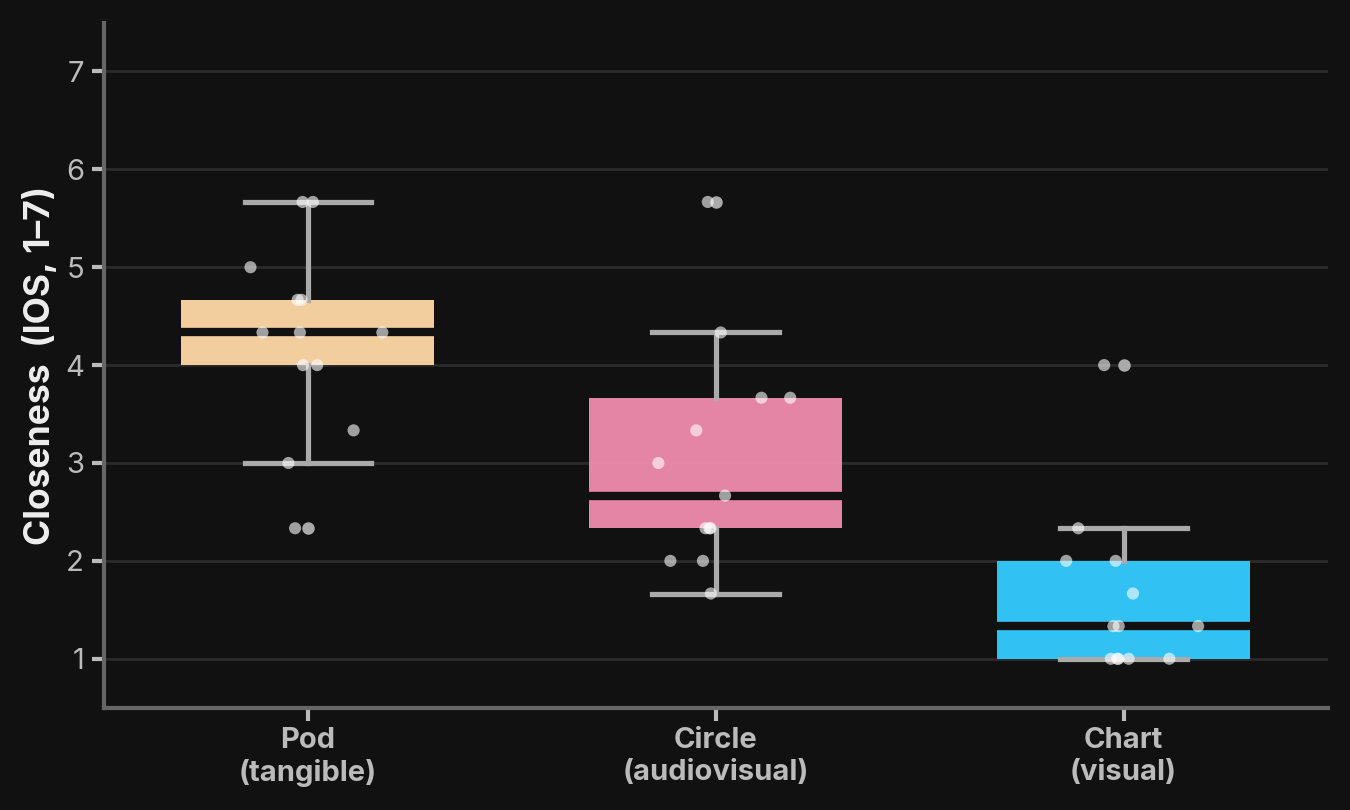
Asked afterward which interface felt most connecting, twelve of the thirteen said the Pod.
It's like I'm holding the heart of this person.
P01, on the Pod
Reading the emotion was another story. No interface let people reliably tell the three states apart, and the circle, the one expected to do best, was no better than the others.
The likely reason is the recordings, not the interfaces: the three were physiologically very close, only a few heartbeats a minute apart, so there may not have been enough difference to detect. What is clear is that the two outcomes came apart.
People felt close to someone whose emotional state they could not read.
I had this feeling that they were feeling sad, and I had no real information about it, but I just felt it.
P08, on the Pod
Feeling close and reading an emotion are independent. Closeness and clarity call for different approaches, and choosing between them is where the design begins.
Still breathing
The study is over, but the work on the Pod continues. It has left the lab, runs on live breath instead of recordings, and is being prepared for testing with real long-distance couples.